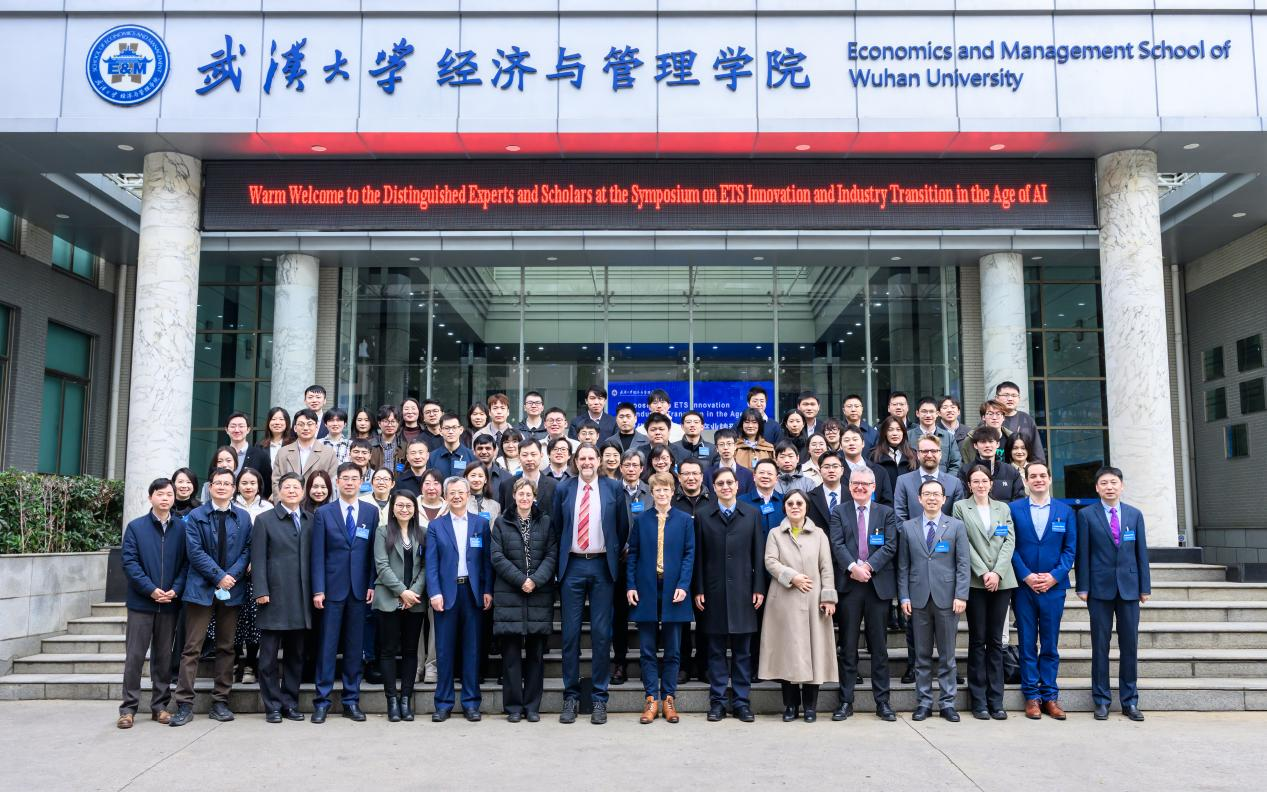
On December 15, 2025, the School of Economics and Management at Wuhan University successfully hosted the "Symposium on Carbon Market Innovation and Industry Transition in the Age of Artificial Intelligence." The symposium was organized by Wuhan University, co-organized by its Center for European Studies, Department of World Economy, Research Center for Climate Change and Energy Economics, and Research Center for Economic Development. It was also supported by the Institute of East Asian Studies at the University of Duisburg-Essen, Germany, and the China Carbon Emissions Registration and Clearing Research Institute. With the strong support of the university's International Exchange Department, the event attracted distinguished experts and scholars from multiple Chinese and German institutions, including Heidelberg University, Ruhr University Bochum, Tsinghua University, and the University of Hong Kong, thereby deepening international cooperative dialogue.
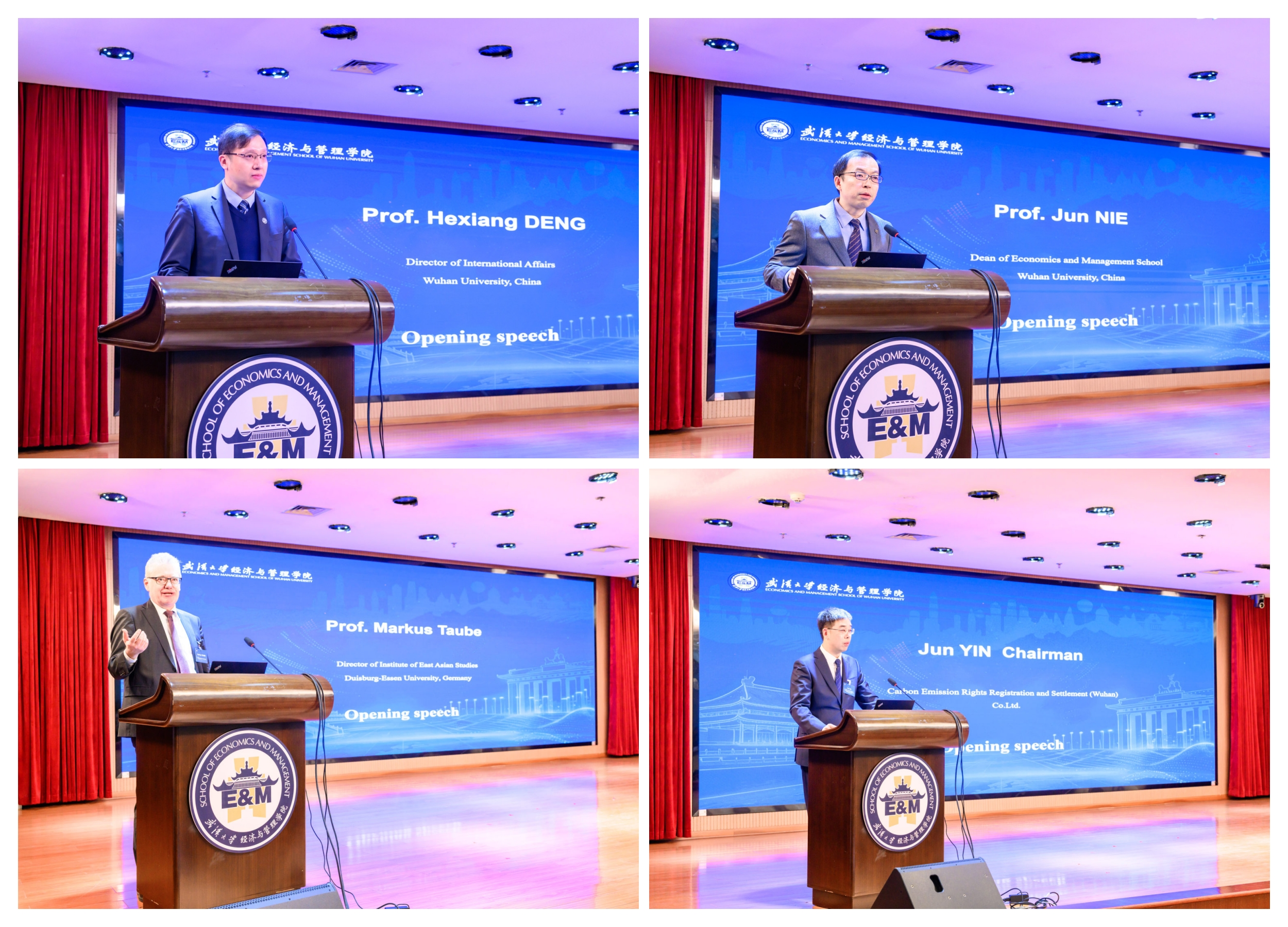
The opening ceremony was presided over by Professor Qi Shaozhou. Professor Deng Hexiang, Director of the International Exchange Department, extended a warm welcome to all guests. He emphasized that AI technology is a crucial driver for global economic and energy transitions. He noted that this symposium provided a valuable learning platform for faculty and students and strengthened Wuhan University's academic exchanges with institutions at home and abroad. Professor Nie Jun, Dean of the School of Economics and Management, elaborated on the symposium's importance from three perspectives. First, amid a volatile global geopolitical landscape, deepening Sino-German climate cooperation is vital for improving carbon markets and industrial upgrading. Second, China's upcoming 15th Five-Year Plan will prioritize green and low-carbon development, with the carbon market being a core tool to achieve the 2030 carbon peak goal. Third, the development of AI will reshape carbon emission monitoring and industrial decision-making. Professor Markus Taube from the University of Duisburg-Essen, Germany, thanked Wuhan University for hosting the event and praised China's innovative achievements for their profound impact on global climate action. Yin Jun, Chairman of China Carbon Emissions Registration and Clearing, pointed out that climate change is a global challenge. He stated that China's carbon market, as a key policy tool under the "Dual Carbon" goals, is entering a new phase, and that AI technology and COP30 will drive its high-quality development.
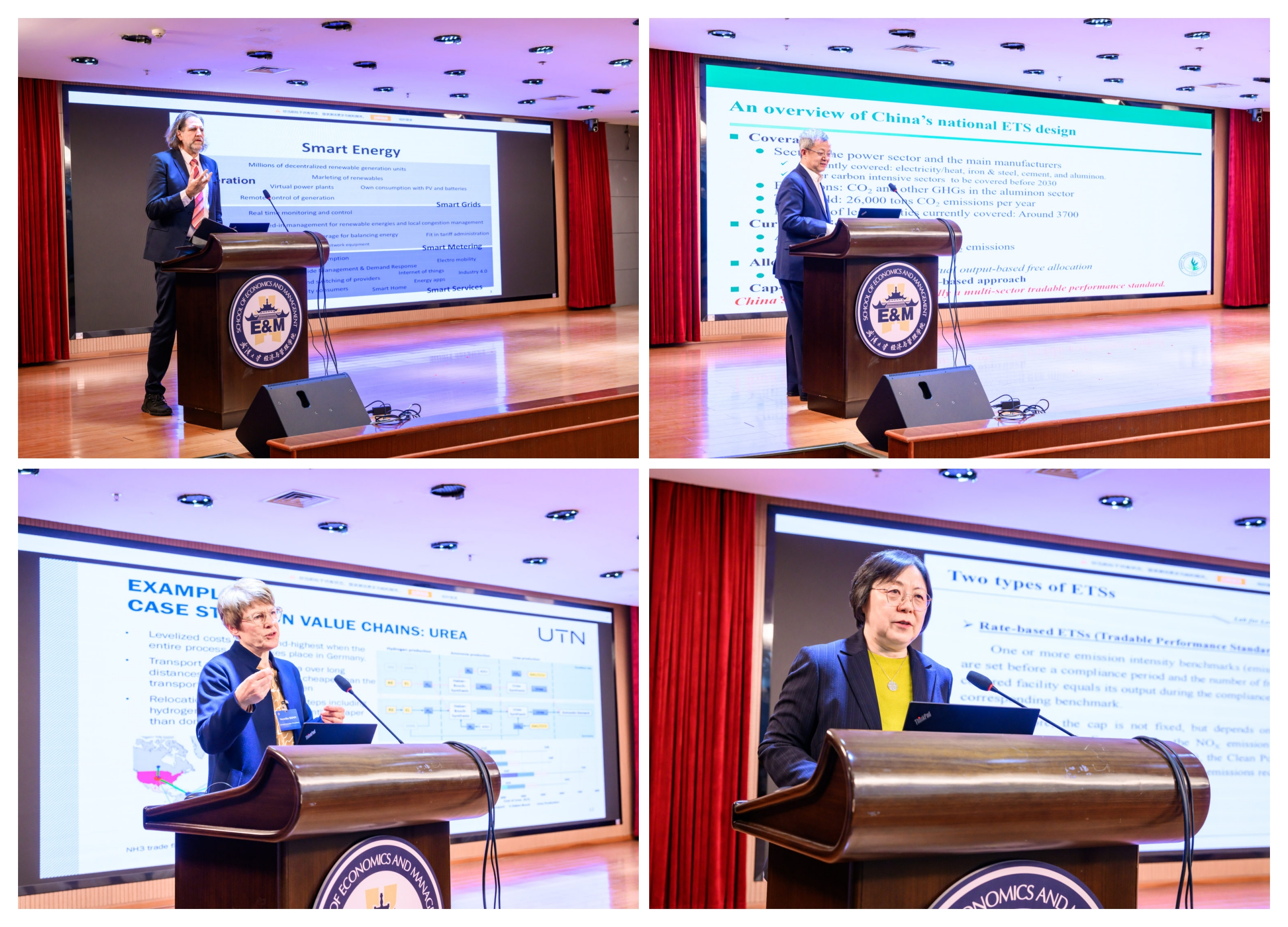
The symposium featured two keynote sessions and interactive segments. The first keynote session was chaired by Professor Anja Senz. Professor Andreas Löschel from Ruhr University Bochum, Germany, in his report titled "Energy Demand Behavior, Digitalisation and AI," emphasized that future energy systems will rely heavily on renewable sources, with AI being key to enhancing efficiency and flexibility. He highlighted the need to address electricity price volatility and advocated for price-based policies over command-and-control approaches. Professor Zhang Xiliang from Tsinghua University, in his report "An Economic Analysis of the Future Development of China's National ETS," stressed that expanding the coverage of the national Emission Trading System (ETS) and introducing allowance auctions can reduce abatement costs. He suggested future policies should focus on improving market efficiency. Professor Veronika Grimm from the Technical University of Nuremberg, Germany, in her report "Industry Transition, Innovation, and Climate Policy in the Age of AI," reiterated the global challenges of industrial decarbonization, fostering innovation-led growth, and climate cooperation. She noted that AI is a driving force for European economic recovery but requires risk regulation, calling for strengthened international collaboration. Professor Fan Ying from Beihang University, in her report "Market efficiency and social welfare under mass- and rate-based emission trading schemes," demonstrated that an intensity-based allowance mechanism can enhance social welfare in imperfectly competitive markets, providing theoretical support for China's carbon market design.
Following this, a Young Faculty Salon was chaired by Dr. Hu Wanling, where scholars including Zhou Li and Sun Wen engaged in in-depth discussions on the direction of carbon market innovation, experiences from domestic and international ETS, and integration with AI.
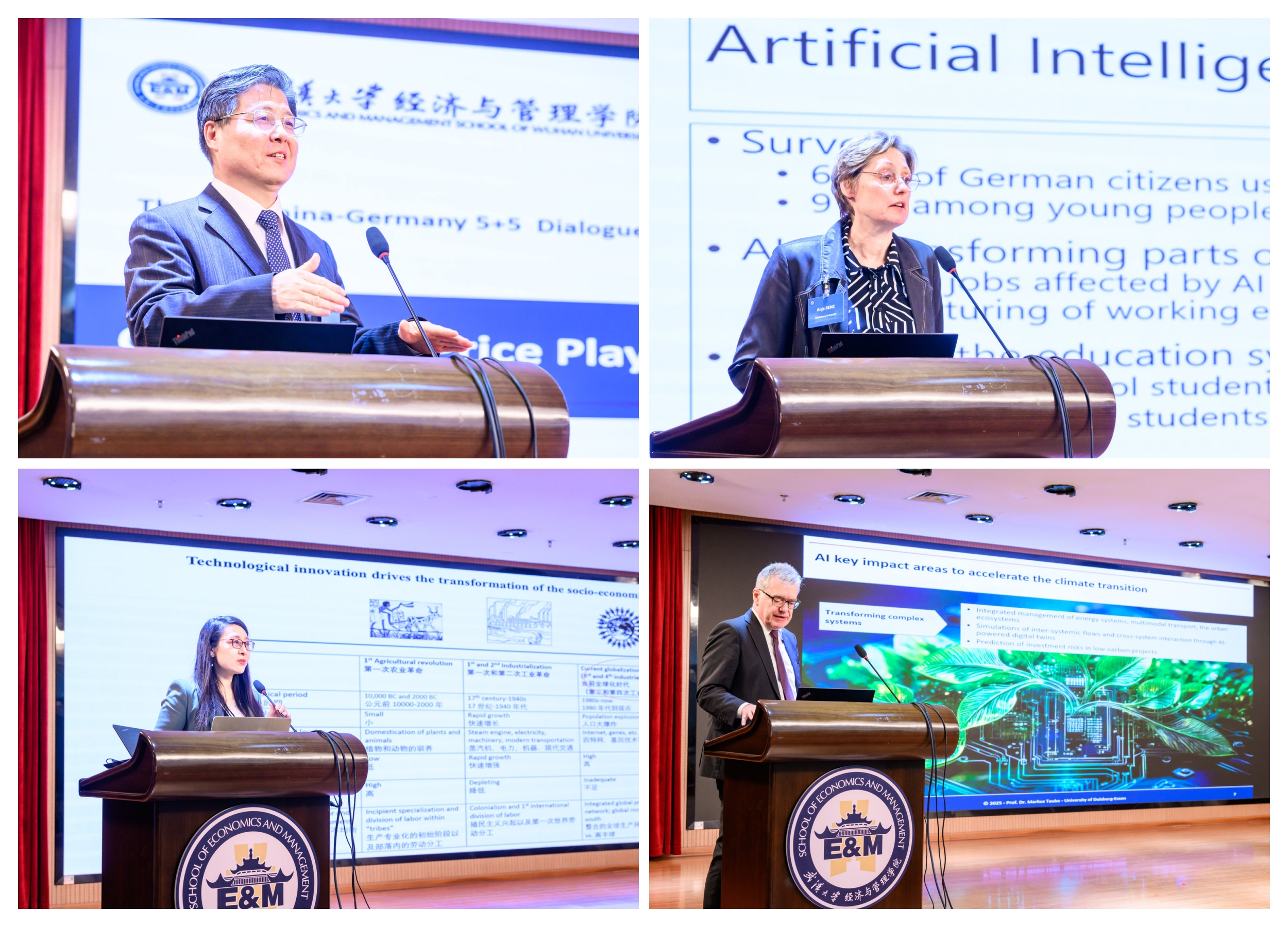
The second keynote session was chaired by Professor Zhang Tianding from the Department of World Economy. Professor Zhang Xiaoling from the University of Hong Kong, in her report "Driving Change: scaling net-zero technology transition," outlined the application of AI in environmental monitoring and energy optimization. She proposed a framework for a digital twin platform for net-zero cities, emphasizing the synergy between data governance and technology policy. Professor Markus Taube from the University of Duisburg-Essen, Germany, in his report "Interim assessment of EU-initiatives for an AI-supported green transition," evaluated EU policies. He pointed out that the AI-driven green transition has not met expectations due to lagging industrial digitalization and geopolitical influences, urging faster implementation. Professor Anja Senz from Heidelberg University, Germany, in her report "Artificial Intelligence, Ethics, and Sustainability: A European Perspective," explored AI ethical issues such as fairness and data protection. She called for integrating sustainability into governance and introduced the EU's risk-based regulatory framework. Professor Qi Shaozhou, in his speech titled "Can Carbon Price Play an Important Role for China's New NDC?" analyzed China's new Nationally Determined Contributions (NDC) target system, dissecting seven major challenges facing the carbon market, including price stability, carbon financial innovation, and coordination with international mechanisms.
A Doctoral Student Roundtable was chaired by Zhou Jingjie, where young scholars including Yao Zhou and Karolin Hofmann enthusiastically discussed ETS innovation in the AI era, opportunities for Sino-European climate cooperation, and pathways for youth engagement.
This symposium established a pragmatic dialogue platform between China and Germany, promoting mutual learning of experiences in carbon market innovation and green industrial transition in the AI era. The research findings and policy recommendations shared by the experts and scholars contributed valuable insights to leveraging market mechanisms, promoting energy digital transformation, and fostering Sino-European climate cooperation. As the host, Wuhan University demonstrated its academic leadership in the field of climate change, continuing its historical mission as a century-old institution in advancing global sustainable development.
Reporters: Wang Xiaowei, Qi Shaozhou, Luo Yu
Reviewers: Huang Minxue, Li Bin

 Faculty and Staff
 Academics
 International Exchange